
What Davis County Tax Records Show
A tax notice in Davis County is a dated snapshot, not a listing for sale. Each notice lists the serial number, tax area, situs address, legal description, and property use. It also carries the values, the taxing entities, and the amounts charged. The Assessor's valuation and the Treasurer's bill appear together. Yet they answer different questions. Always read the tax year and the notice date first. That step keeps figures apart. It stops a number from being compared against the wrong source.
| Field | What It Shows | Where |
|---|---|---|
| Market value | Assessor's full-value estimate as of the tax valuation date | Assessor / notice |
| Taxable value | Value remaining after any applicable exemption | Assessor / notice |
| Property use | Primary or non-primary residence treatment | Assessor / notice |
| Taxing entities | Entities and tax amounts charged to the parcel | Treasurer / notice |
| Balance and status | Bill, payment, delinquency, or sale information | Treasurer |
In Utah, assessors set taxable value at full fair market value each January 1. An exemption can lower the number that actually gets taxed. Either way, these figures are not what a buyer paid, since a recorded deed shows the sale price and a private appraisal serves a different purpose. Davis County tax records describe value for the tax roll, not the market.
Davis County Tax Notice Fields
One published 2022 Davis County notice shows how the fields fit together. The sample lists serial number 12-920-0008, tax area 64, and a West Point situs address. Its legal description is Lot 8 in Craythorn Homestead Phase 1. Market value and taxable value sit in separate fields. Taxing entities and their amounts are itemized as well. The notice also states that a full-time primary residence is taxed at 55 percent of market value for the first acre. Non-primary property is taxed at the full 100 percent.
For that sample, the residential primary building and land show a combined market value of $642,000. The taxable value is $353,101. Those numbers belong to that notice alone, not to any current Davis County estimate. A notice never shows the recorded sale price. For that fact, pull the parcel's deed record and its own current notice.
For current tax information, see the Davis County Treasurer.
Confirm the tax year, land serial, values, and taxing entities for a specific parcel on its current notice.
Davis County Primary Residence Exemption
Utah's primary-residence exemption can drop taxable value to 55 percent of fair market value. It covers a qualifying home and up to one acre. The owner or a tenant must use the residence as a primary home for at least 183 days in a calendar year, according to the Assessor. Each household gets one primary residence. Most other locally assessed real property stays taxable at full fair market value. Agricultural land, though, may be treated differently.
Davis County's Residential Property Declaration asks for a parcel number and a PIN. When a letter's mailing address differs from the property's physical address, a declaration may be due within 90 days. Ignore the letter and the exemption can vanish. That lifts the taxable value. Follow the notice instructions from the Assessor. Eligibility and filing rules belong to the county rather than to a map's owner field.
Before responding to any county letter, read the Davis County Residential Property Declaration.
Looking Up a Davis County Tax Bill
The Treasurer's public page connects property search, tax notices, payment information, and delinquent-property notices. It puts them all in one place. Search by address or serial number first. Then confirm the current year and the payment status. For value or exemption questions, the Assessor's parcel detail is the better tool. A tax area simply groups the taxing entities applied to a parcel. It is not a neighborhood name or a legal boundary.
- Open the Davis County Treasurer's property tax search and locate the parcel.
- Record the tax year, tax area, amount due, and payment or delinquency status.
- Compare market and taxable value with the Assessor's parcel information.
- Check whether an exemption appears and read the notice for instructions.
- Market value
- The Assessor's estimate of fair market value as of January 1.
- Taxable value
- The portion used to calculate tax after an exemption is applied.
- Tax area
- The taxing area and entities associated with the parcel.
- Delinquent tax
- An unpaid amount shown as past due in the Treasurer's records.
Davis County Valuation Calendar
The Assessor mails valuation notices by July 22. Utah then allows an appeal within 45 days after the mailing. In the alternative, the deadline is September 15, whichever comes later. The current Board of Equalization page has listed September 15 in one notice. Another notice on that page has listed September 16. The page changes with each tax year. Trust the deadline printed on the live year's instructions instead of a date borrowed from an old notice.
An appeal challenges the assessed value. It cannot rewrite a deed or erase a tax bill. Keep the notice and remember when it arrived. A strong value challenge lays out the property facts or comparable evidence that make the estimate wrong for the relevant date.
Appealing a Davis County Assessment
File with the Davis County Board of Equalization using the current original appeal form. Use a late-appeal application if the regular window has closed. The Assessor advises that a useful case shows the value is wrong. It can also show the value is out of line with similar properties in location, style, quality, size, and condition. A mere difference of opinion is not a factual error.
Good evidence might include closing papers signed by the title agent. A certified appraiser's report also works. At least three comparable sales near January 1 also work. So does income analysis for commercial or rental property. Proof of a factual mistake, like a wrong area or garage description, counts too. An agent must have authorization, and the county requires it notarized when applicable.
Before filing, review the current Board of Equalization appeal instructions.
Use the live appeal notice to check the current deadline and required form version.
Appeal window. The deadline is 45 days after the valuation notice is mailed or September 15, whichever is later. Davis County's live notices may say September 15 or 16, so follow the notice for the current tax year.
Davis County Delinquent Tax Lists
The Treasurer publishes delinquent-property notices that identify a land serial number, an owner of record as of the notice date, and the amount then due. The county's 2023 notice, for example, stated an amount as of December 15, 2023, including penalty. Current pages link annual results for 2023 through 2026. A list is a dated snapshot, not a statement of today's balance or current title.
Before using a delinquency entry, match the serial to the parcel and read the date printed on the notice. If the property later went to sale, find the final recorded tax deed and review the Recorder chain. The Treasurer collects the bid and recording fee after the auction. Sale terms and the recorded instrument control the next step.
Davis County Tax Sale Results
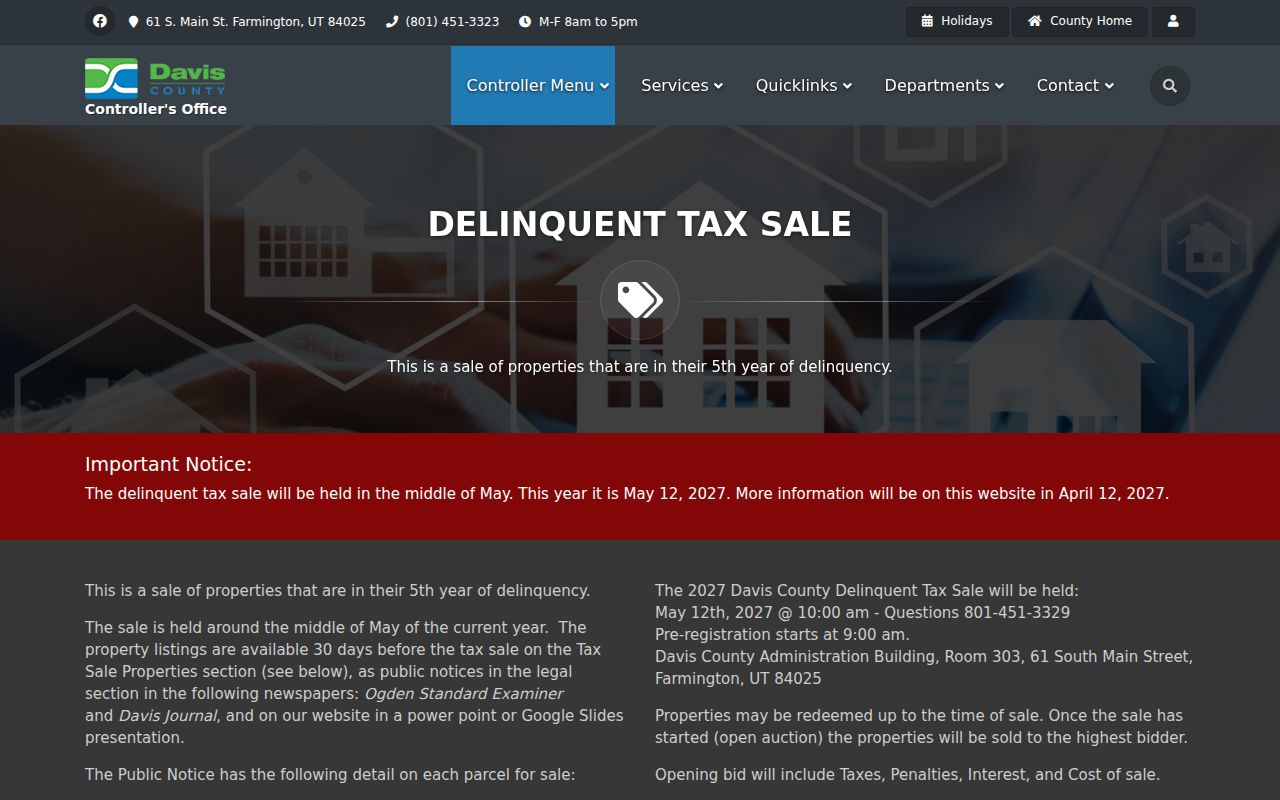
Davis County posts delinquent-sale listings on its delinquent tax-sale page. Annual results appear there too. The page carries a blunt label: Buyer Beware. The county is direct about what a buyer gets. The purchaser receives a recorded tax deed, similar to a quitclaim deed. The buyer must research the property personally. A result PDF is only a record of the auction. It clears no liens, and it settles no bankruptcy question. It proves nothing about who owns the parcel now. Check the Recorder's instrument and the sale terms first.
Start with the county's current sale page. Then confirm any transfer in the Recorder's land index before drawing conclusions.
Davis County Tax Office Roles
Several offices share the answer to a tax question. Each owns one piece of the record. The Assessor estimates fair market value and sets the classification used on the tax roll. The Treasurer is different. That office bills and collects property taxes, shows payment status, and publishes delinquent-property information. The Tax Administration group handles Board of Equalization appeals and related administration. Ask the right office. A single parcel page will not answer every question about a value notice. It also will not cover an amount due or an appeal.
For payment or delinquency questions, the Davis County Treasurer lists 801-451-3243. For tax administration, the county lists 801-451-3331, 801-451-3329, and the email taxadmin@daviscountyutah.gov. Have the serial number ready. Also note the tax year and tax area. A parcel address alone may not separate a corrected bill from a prior owner's notice. It may not separate an older tax-sale entry either.
Read any notice as a dated document. A delinquency amount includes penalty figured through the printed date, and it can shift after payment, sale, or a later adjustment. The Treasurer's lookup shows the present balance. Last year's market value does not carry forward automatically. Neither does an exemption. Compare the year, the owner named as of the document date, and the land serial before drawing any tax conclusion. Check them again before drawing any ownership conclusion.
Pair the tax area with the serial when comparing bills. The tax area names the mix of taxing entities applied to a parcel. Two nearby addresses can fall in different tax areas. Similar market values can still produce different totals. Remember what the bill is not. It is not a property appraisal, and the market-value field is not the amount owed. Sort the notice into taxable value, rates and charges, credits, payments, and any delinquent balance. Then verify the current balance in the Treasurer's system before paying.